Leprosy is one of the world’s oldest diseases—yet it remains a lived reality for thousands of people in India today. Although the disease is completely curable, delayed diagnosis, stigma, and social exclusion continue to cause preventable disability.
India achieved the elimination of leprosy as a public-health problem in 2005, but elimination is not eradication. The country still reports the highest number of new cases globally, contributing to more than half of the world’s burden. In 2024 alone, 100,957 new cases were detected, with an Annual New Case Detection Rate of 7.00 per 100,000 population. Hidden cases, children affected by leprosy, and people diagnosed with visible disabilities clearly show that transmission continues—and that sustained, focused action remains essential.
After elimination was declared, leprosy gradually lost priority within health systems. Surveillance weakened, resources declined, and clinical expertise reduced—leaving many cases undetected or diagnosed too late. Stigma deepens this challenge. Fear and misinformation delay care-seeking, isolate families, and deny people dignity and rights.
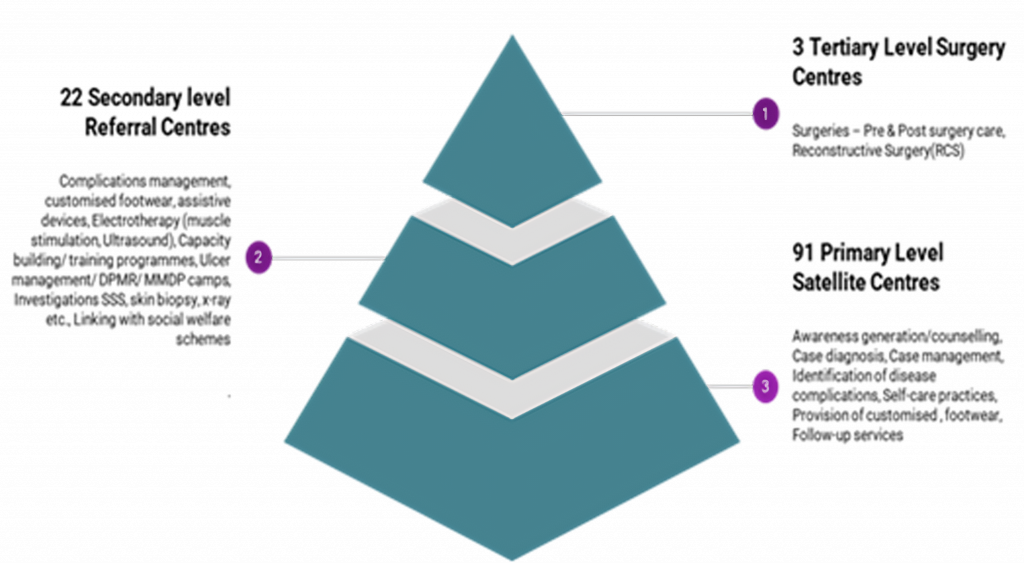
Since 1989, LEPRA Society has worked alongside persons affected by leprosy, delivering a comprehensive, people-centred approach that addresses health, rehabilitation, livelihoods, dignity, and inclusion.
LEPRA focuses on high-endemic and underserved districts across India:
Telangana | Andhra Pradesh | Assam | Bihar | Jharkhand | Odisha | Madhya Pradesh | Uttar Pradesh | Chhattisgarh | Delhi
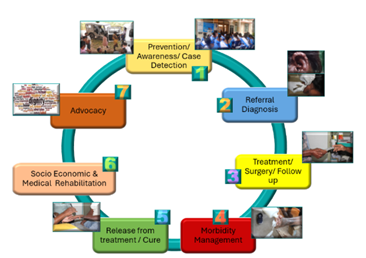
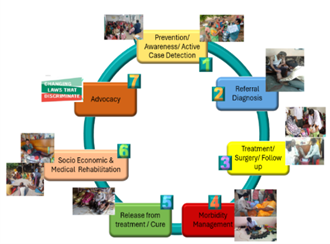
Lymphatic filariasis (LF) is a mosquito-borne disease and a leading cause of chronic disability in India. It causes lymphoedema, elephantiasis, and hydrocele, leading to stigma, loss of income, and reduced quality of life.
India bears the largest share of the global LF burden, with roughly 31–45 million infected and 400–550+ million at risk. Despite long-standing elimination efforts, persistent transmission, treatment gaps, and socio-economic barriers mean the disease continues to affect vulnerable communities.
LF often affects the most vulnerable—rural, migrant, and low-income communities. Even where treatment is available, fear of side effects, limited awareness, and poor access reduce participation in Mass Drug Administration (MDA) programmes. Chronic disability and visible symptoms amplify stigma, isolate families, and limit opportunities for education and work.
Since 2006, LEPRA Society has worked with communities affected by LF. What began as treatment facilitation support has evolved into a comprehensive, people-centred approach addressing health, livelihoods, disability prevention, and social inclusion.
LEPRA focuses on high-endemic and underserved districts across India: Telangana | Andhra Pradesh | Assam | Bihar | Jharkhand | Odisha | Madhya Pradesh | Uttar Pradesh | Chhattisgarh | Delhi
Tuberculosis (TB) remains one of India’s most serious public health problems. The country carries the highest TB burden globally, accounting for roughly a quarter of the world’s TB cases, including drug-resistant TB. Each year, over 2.6 million people develop TB in India, with hundreds of thousands of deaths. Latent TB infection affects an estimated 36–41% of the population, creating a large reservoir for future disease.
TB disproportionately affects poor, malnourished, densely housed, and socially vulnerable populations, including urban slum dwellers, tribal communities, and those with limited access to healthcare.
LEPRA works in all districts of Chhattisgarh
India has an estimated 2.1–2.4 million people living with HIV (PLHIV). While adult prevalence is relatively low (~0.22–0.26%), the epidemic is concentrated in key populations: female sex workers, men who have sex with men, people who inject drugs, transgender people, their partners and incarcerated populations. New infections and AIDS-related deaths have declined over the past two decades thanks to antiretroviral therapy (ART) and targeted interventions, but state-level disparities and persistent hotspots remain.
HIV/AIDS thrives in settings of stigma, criminalization, and social marginalization. Limited access to prevention, testing, and treatment in key populations, coupled with gender and social inequalities, prevents full epidemic control.
LEPRA supports PLHIV through prevention, care, treatment adherence, and advocacy, addressing both medical and social needs.
LEPRA focuses on high-burden and underserved districts across India: Maharashtra | Andhra Pradesh | Telangana | Madhya Pradesh
Millions in India suffer from visual impairment or blindness, yet over 90% of cases are preventable or treatable. Cataracts, uncorrected refractive errors, diabetic retinopathy, and corneal diseases affect adults, while rising myopia and vision problems impact children’s learning and development. Poor eye health limits opportunities and quality of life, making timely detection and care essential.
Access to eye care is limited, particularly in rural and tribal areas. Chronic conditions such as diabetes increase the risk of complications, and inadequate screening can lead to long-term disadvantages.
LEPRA delivers comprehensive eye care through secondary and tertiary hospitals—including Mahanadi Netra Chikitsalaya, Junagarh Netra Chikitsalaya, and Jharsiguda Netra Chikitsalaya—along with eye clinics providing inpatient and outpatient services. Care includes cataract and glaucoma surgeries, diabetic retinopathy management, and other essential treatments.
LEPRA focuses on underserved rural and tribal areas: Bihar | Odisha
Partnering to eliminate disease, restore dignity, and build inclusive communities.