Leprosy is curable, but for thousands of people in India, its consequences can still be life-changing. When diagnosis is delayed, the disease can cause irreversible nerve damage, lifelong disabilities, and social exclusion. Although effective treatment is freely available, stigma and misinformation often prevent people from seeking care until complications have already developed.
India achieved the elimination of leprosy as a public health problem in 2005, but elimination does not mean the disease has disappeared. The country continues to report the highest number of new cases globally, accounting for more than half of the world’s burden. In 2024 alone, *100,957* new cases were detected, while new infections among children and people diagnosed with visible disabilities indicate that transmission continues. Sustained efforts are therefore essential to detect the disease early, prevent disability, and break the cycle of stigma.
Leprosy continues to affect some of the most underserved communities in India, where access to timely diagnosis and specialised healthcare remains limited. Poverty, distance from health services, low awareness, and persistent stigma often delay diagnosis, increasing the risk of disability and prolonged social exclusion.
The impact extends far beyond health. A diagnosis can disrupt education, livelihoods, relationships, and opportunities, making recovery as much about restoring dignity and inclusion as it is about curing the disease.
For more than three decades, LEPRA Society has supported people affected by leprosy to access timely healthcare, prevent disability, rebuild their lives, and live with dignity. Working alongside governments, healthcare providers, and communities, our programmes span 146 districts across 11 states, with a strong focus on high-endemic and underserved areas.
Our work brings together community outreach, early detection, quality clinical care, disability prevention, rehabilitation, research, innovation, and advocacy to ensure that every person affected by leprosy receives comprehensive care and long-term support.
For many people affected by leprosy, the journey does not end with a cure. Nerve damage can lead to loss of sensation, ulcers, deformities, and lifelong disability if left unmanaged. LEPRA Society provides comprehensive disability prevention and rehabilitation services, including customised Micro Cellular Rubber (MCR) footwear, reconstructive surgery, self-care education, physiotherapy, and livelihood support. By helping people regain mobility, independence, and confidence, we enable them to rebuild their lives with dignity.
Leprosy care does not end with diagnosis, and neither does our support.
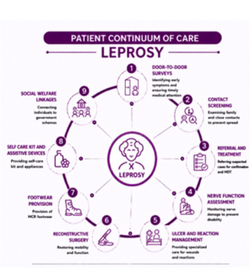
Through our Continuum of Care, LEPRA Society delivers integrated, person-centred services at every stage of the journey from prevention and early detection to diagnosis, treatment, disability prevention, rehabilitation, and social inclusion. Delivered through a network of primary, secondary, and tertiary referral centres, this holistic approach helps prevent disability, restore independence, and enable people affected by leprosy to participate fully in their families and communities.
Ending leprosy requires strong and responsive health systems. LEPRA Society works closely with the National Leprosy Eradication Programme (NLEP) and state governments to strengthen service delivery through technical support, capacity building, operational research, improved surveillance, referral systems, and digital innovations such as DiMPLE.
We also partner with organisations of persons affected by leprosy to reduce stigma, amplify lived experiences, and advocate for policies that promote dignity, inclusion, and equal opportunities. By strengthening health systems and empowering communities, we help ensure that quality leprosy services reach those who need them most.
Every early diagnosis, every disability prevented, and every life restored brings us one step closer to a future free from leprosy.
Lymphatic filariasis (LF) is preventable, yet it continues to affect millions of people in India, causing lifelong disability and social exclusion. Transmitted through mosquito bites, the disease can lead to lymphoedema, elephantiasis, and hydrocele, conditions that limit mobility, affect livelihoods, and reduce quality of life. Although significant progress has been made towards eliminating LF, many people continue to live with its long-term physical, social, and economic consequences.
India bears the largest share of the global burden of lymphatic filariasis, with an estimated 31–45 million people infected and over 400 million people at risk. Persistent transmission in endemic districts, gaps in Mass Drug Administration (MDA) coverage, and challenges in managing chronic disability mean that sustained efforts are still essential not only to interrupt transmission and achieve elimination, but also to ensure that people living with LF receive the lifelong care, rehabilitation, and support they need.
Across many endemic districts, people continue to face barriers to preventing and managing lymphatic filariasis. Limited access to healthcare, low awareness, misinformation, and fear of side effects can reduce participation in Mass Drug Administration (MDA) and delay case detection.
For people living with chronic lymphoedema or hydrocele, the disease affects far more than physical health. It can impact mobility, livelihoods, confidence, and social participation, highlighting the need for comprehensive care that extends beyond treatment.
For nearly two decades, LEPRA Society has supported national efforts to eliminate lymphatic filariasis while improving the quality of life of people living with the disease. Working alongside governments, healthcare providers, and communities, our programmes focus on high-endemic and underserved districts where the need is greatest.
Our work spans the entire spectrum of care from community awareness, case detection, and support for Mass Drug Administration (MDA) to Morbidity Management and Disability Prevention (MMDP), rehabilitation, and social inclusion. By combining public health interventions with person-centred care, we help interrupt transmission while ensuring that people affected by LF receive the long-term support they need to lead healthier, more independent, and dignified lives.
Eliminating lymphatic filariasis means more than preventing new infections it also means improving the lives of people already living with the disease. LEPRA Society supports individuals with chronic lymphoedema and hydrocele through Morbidity Management and Disability Prevention (MMDP), self-care education, hydrocele surgery, protective footwear, rehabilitation, and psychosocial support. Our approach helps reduce disability, improve mobility, and restore quality of life while contributing to India’s goal of eliminating LF.
Lymphatic filariasis requires more than treatment alone. Preventing new infections and supporting people living with chronic conditions must go hand in hand.
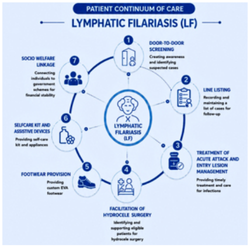
Through our Continuum of Care, LEPRA Society provides integrated, person-centred services across every stage of the disease pathway from community awareness, case detection, and Mass Drug Administration (MDA) to Morbidity Management and Disability Prevention (MMDP), rehabilitation, and social inclusion. This holistic approach not only contributes to India’s goal of eliminating lymphatic filariasis but also helps people affected by the disease regain mobility, restore independence, and improve their quality of life.
Eliminating lymphatic filariasis requires sustained community participation and strong public health systems. LEPRA Society works closely with the National Programme for Elimination of Lymphatic Filariasis (NPELF) and state governments to strengthen Mass Drug Administration (MDA), improve Morbidity Management and Disability Prevention (MMDP) services, build the capacity of healthcare workers, and enhance community engagement.
Through technical support, operational research, and partnerships with governments and communities, LEPRA Society contributes to stronger health systems, supports India’s journey towards eliminating lymphatic filariasis, and helps ensure that no one living with the disease is left behind.
Tuberculosis (TB) remains one of India’s most significant public health challenges, despite being both preventable and curable. India carries the highest TB burden globally, accounting for nearly a quarter of all TB cases worldwide, including multidrug-resistant tuberculosis (MDR-TB). Every year, more than 2.6 million people develop TB, and thousands continue to lose their lives to a disease that can be effectively diagnosed and treated.
TB is closely linked to poverty, malnutrition, overcrowding, and limited access to healthcare. An estimated 36–41% of India’s population is infected with latent TB, creating a large reservoir for future disease. Children remain particularly vulnerable, as TB is often more difficult to diagnose in them, making early detection and timely treatment essential. Achieving India’s goal of eliminating TB requires sustained efforts to improve diagnosis, strengthen treatment adherence, prevent drug resistance, and ensure that no one is left behind.
Across many communities, barriers such as poverty, malnutrition, stigma, and limited access to healthcare continue to delay TB diagnosis and treatment. People living in tribal communities, remote areas, urban slums, and other underserved settings often face the greatest challenges in accessing timely, quality care.
The burden is further compounded by multidrug-resistant TB (MDR-TB), under-notification of cases, and gaps in healthcare access. Addressing these challenges requires more than medical treatment—it demands stronger health systems, increased community awareness, early diagnosis, and sustained support throughout the treatment journey.
For more than two decades, LEPRA Society has partnered with governments, healthcare providers, and communities to strengthen TB prevention, detection, diagnosis, and treatment support. Working across Chhattisgarh, our programmes contribute to the state’s efforts to eliminate tuberculosis while improving access to quality TB services for underserved communities.
Our work includes community awareness, case detection, treatment facilitation, counselling, private sector engagement, and laboratory diagnosis, including culture and drug susceptibility testing (DST) for Mycobacterium tuberculosis. We also place a strong emphasis on paediatric TB, supporting early identification and timely treatment for children, who often face unique diagnostic and clinical challenges. Through these interventions, LEPRA Society supports the National TB Elimination Programme (NTEP) and helps improve patient outcomes.
Tuberculosis in children is often difficult to detect because symptoms can be less specific than in adults. Delayed diagnosis can increase the risk of severe illness and long-term complications. LEPRA Society works closely with communities and the National TB Elimination Programme (NTEP) to support the early identification, referral, diagnosis, and treatment of paediatric TB, helping children receive timely care and giving them the best chance for a healthy future.
Eliminating tuberculosis requires strong health systems that can detect every case, ensure timely diagnosis, and support people throughout treatment. *LEPRA Society* works closely with the National TB Elimination Programme (NTEP) to strengthen service delivery through technical support, capacity building, laboratory strengthening, surveillance, and community engagement.
Our research expertise through the *Blue Peter Public Health & Research Centre (BPHRC)* enhances TB diagnosis, including culture and drug susceptibility testing, while generating evidence that strengthens programme implementation and improves the quality of TB care.
Every person diagnosed early and supported throughout treatment brings India one step closer to eliminating tuberculosis.
Advances in treatment have transformed HIV into a manageable chronic condition, yet stigma, discrimination, and unequal access to healthcare continue to affect millions of people. With timely diagnosis and lifelong antiretroviral therapy (ART), people living with HIV can lead long, healthy, and productive lives. However, barriers to prevention, testing, treatment, and social support continue to leave many vulnerable communities behind.
India is home to an estimated 2.1–2.4 million people living with HIV (PLHIV). While the national adult prevalence remains relatively low, the epidemic is concentrated among key populations, including female sex workers, men who have sex with men, people who inject drugs, transgender persons, their partners, and incarcerated populations. Sustaining progress requires continued investment in prevention, early diagnosis, uninterrupted treatment, and efforts to eliminate stigma and discrimination.
Despite significant progress, many people continue to face barriers to HIV prevention, testing, and treatment. Stigma, discrimination, gender inequalities, and social exclusion often discourage individuals from seeking healthcare or continuing treatment. These challenges are particularly pronounced among key populations and in communities with limited access to health services.
Beyond the medical impact, HIV can affect mental wellbeing, livelihoods, family relationships, and social inclusion. Addressing HIV therefore requires a people-centred approach that combines healthcare with counselling, community support, and the protection of rights.
For more than two decades, LEPRA Society has worked alongside governments, healthcare providers, and communities to strengthen HIV prevention, care, and support services. Our programmes focus on high-burden and underserved districts across Andhra Pradesh, Maharashtra, Madhya Pradesh, Telangana, and Odisha, reaching people who are often excluded from essential healthcare services.
Our work includes HIV prevention, counselling, screening, treatment adherence support, nutritional assistance, community mobilisation, and advocacy. Working closely with the National AIDS Control Programme (NACP) and local partners, we help improve access to care, strengthen treatment continuity, and support people living with HIV to lead healthy, productive, and dignified lives.
LEPRA Society expands access to HIV services for people who are often underserved by the health system, including those in correctional facilities and other vulnerable settings. Through HIV screening, counselling, referral, and linkage to Antiretroviral Therapy (ART), we help ensure that individuals receive timely care and remain connected to treatment and support services.
Ending HIV as a public health threat requires strong health systems, sustained partnerships, and communities free from stigma. LEPRA Society works with government programmes, healthcare institutions, correctional facilities, and community-based organisations to strengthen HIV screening, referral systems, linkage to Antiretroviral Therapy (ART), treatment adherence, and follow-up care.
Through capacity building, technical support, and community engagement, we contribute to more accessible, inclusive, and person-centred HIV services while promoting dignity, equity, and the rights of people living with HIV.
Every person tested, linked to treatment, and supported to remain in care brings us closer to ending HIV as a public health threat.
Good vision changes lives, yet millions of people in India continue to live with avoidable visual impairment and blindness. More than 90% of vision loss is preventable or treatable through timely screening, diagnosis, and quality eye care. However, many people—particularly those living in rural and underserved communities—continue to lose their sight because essential eye care remains out of reach.
Cataracts, uncorrected refractive errors, diabetic retinopathy, glaucoma, corneal diseases, and other eye conditions remain major causes of visual impairment. In children, poor vision can affect learning and development, while in adults and older people, it can reduce independence, productivity, and quality of life. Protecting sight requires timely intervention and equitable access to comprehensive eye care services.
Across many rural and tribal communities, access to quality eye care remains limited. Distance from specialised services, delayed diagnosis, low awareness, and financial barriers often prevent people from seeking treatment until their vision has significantly deteriorated.
Vision loss affects far more than eyesight. It can limit education, employment, mobility, and independence, making accessible, affordable, and quality eye care essential to improving health and wellbeing.
For over two decades, LEPRA Society has been delivering comprehensive eye care services to underserved communities, helping prevent avoidable blindness, restore sight, and improve quality of life. Our programmes focus on expanding access to quality eye care across Bihar and Odisha, with a strong emphasis on rural and tribal populations.
Through a network of secondary and tertiary eye care hospitals including Mahanadi Netra Chikitsalaya, Junagarh Netra Chikitsalaya, and Jharsuguda Netra Chikitsalaya along with vision centres and community outreach programmes, we provide a continuum of eye care from screening and diagnosis to treatment, surgery, and follow-up care.
Our services include cataract surgery, glaucoma management, diabetic retinopathy care, refractive services, corneal disease management, lagophthalmos assessment and corrective surgery, low vision services, and the provision of spectacles and other assistive devices. By combining specialist care with community outreach, we ensure that people receive timely, affordable, and high-quality eye care closer to their communities.
From restoring sight through cataract surgery to managing complex eye conditions such as diabetic retinopathy and lagophthalmos a condition that can occur in people affected by leprosy and may lead to vision loss if left untreated LEPRA Society brings specialist eye care closer to people through hospitals, vision centres, and community outreach. Early diagnosis, timely referral, and quality treatment help preserve vision, prevent disability, and improve quality of life.
Preventing avoidable blindness requires strong and accessible eye care services. *LEPRA Society* works closely with government health departments, local communities, and healthcare professionals to strengthen referral pathways, expand community-based screening, build the capacity of healthcare workers, and improve access to quality eye care.
By combining specialist hospitals, vision centres, outreach services, and health system strengthening, we are helping create a future where preventable blindness is no longer a barrier to health, education, livelihoods, or opportunity.

Transforming lives through healthcare, dignity, inclusion, and hope together.
Transforming lives through healthcare, dignity, inclusion, and hope together.
Your support helps transform lives.

WhatsApp us
Be the first to know about our moving stories, new projects, and opportunities. Join our community of changemakers today!